Charlotte Salomon
Charlotte Salomon (1917 to 1943) was a German-Jewish artist who, in the years before her death at Auschwitz, painted nearly 800 gouaches and edited them into a single, indefinable work she called Life? or Theatre?. She subtitled it A Play With Music and structured it like a Singspiel, an old form of opera blending visual art, written text, and musical references. It is one of the most extraordinary artworks of the 20th century, and was shown in its entirety for the first time at the Joods Cultureel Kwartier in Amsterdam.
I led development of the digital companion. The app launched first on iPads inside the gallery, with the original interaction design by Total Design, and then as a public-facing site at charlotte.jck.nl.
Respecting the Singspiel
Salomon ordered her paintings deliberately. Life? or Theatre? opens with a Prelude, builds through a Main Section, and resolves in an Epilogue, with separate categories for unnumbered pages and letters. She also assigned a piece of music to many paintings, songs she hummed while she worked and noted on the reverse of each page.
The digital experience holds onto that order. Visitors can browse the program from start to end, jump into any of the six sections, or step page by page through the entire 970-record archive. Filters by character and theme are tucked behind a button so they don't compete with the work itself.
A page at a time
Each painting opens in a quiet two-column layout: the gouache on the left, the accompanying text on the right, with a paginated arrow to step forward. The text was translated into multiple languages and recorded by professional voice actors, so a visitor can sit with one painting, hear the words Salomon set against it, and move on at their own pace.
The narration is anchored to each page: pause it, change languages, or scrub back, and the audio stays with the painting you're looking at. Subtitles also follow the timing of the recording for visitors who prefer to read along.
High-resolution, zoomable canvas
The original gouaches contain extraordinary detail: written notes, brushwork variations, painted-on overlays of color. To make those legible, every painting is served as a tile pyramid, the same approach maps use, so visitors can pan and zoom into any part of the page without the file-size cost of a single huge image.
Mobile
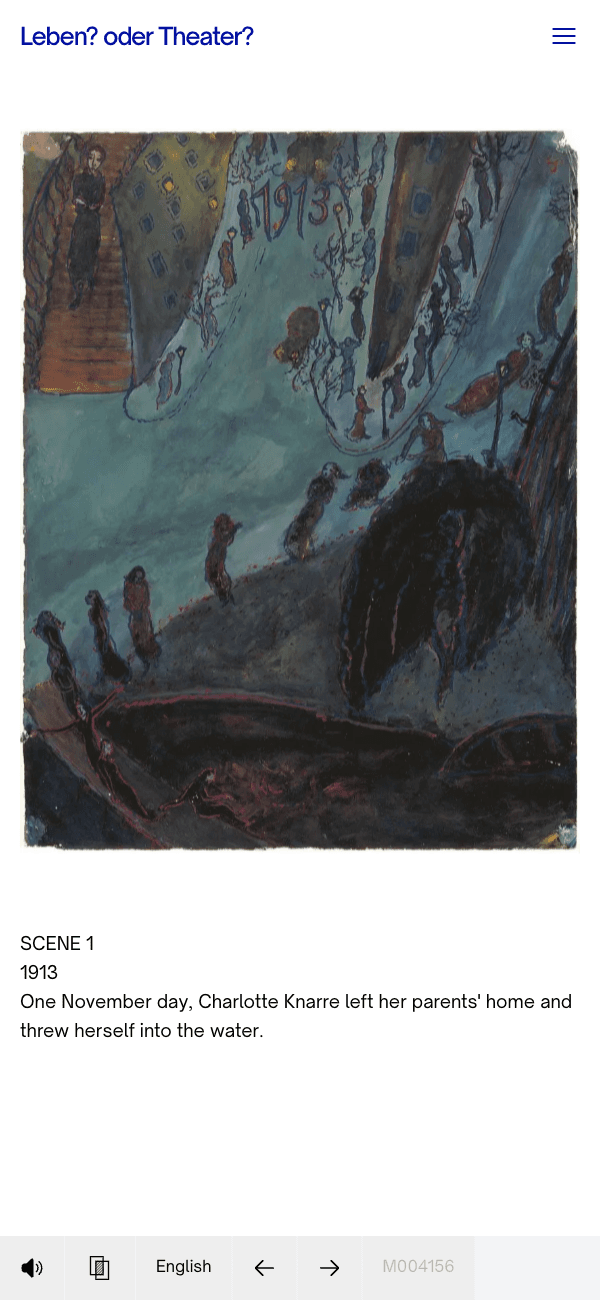
The gallery iPad layout was the starting point, but the public site needed to work on a phone too. A single-column reflow stacks the painting above its narration, keeps the audio control persistent at the bottom, and preserves the same forward and backward pagination through all 970 records.
In the museum's hands
The paintings, the narration texts, and the audio recordings all come from the museum's own systems, so the curators control the work end-to-end without going through code. When the exhibition team adjusts a translation or re-records a narration, the site follows.
The site is live at charlotte.jck.nl.